


Kay is a Filipina-American writer, former inclusion strategist, and counsellor‑in‑training who moved from California to Madrid “for a year or two,” and never left.
She writes about the no‑longer‑new, still‑not‑home phase of life abroad for long‑term expats and global citizens at Edgewalkers Collective.
This is her letter to the woman she was before she moved 16 years ago.
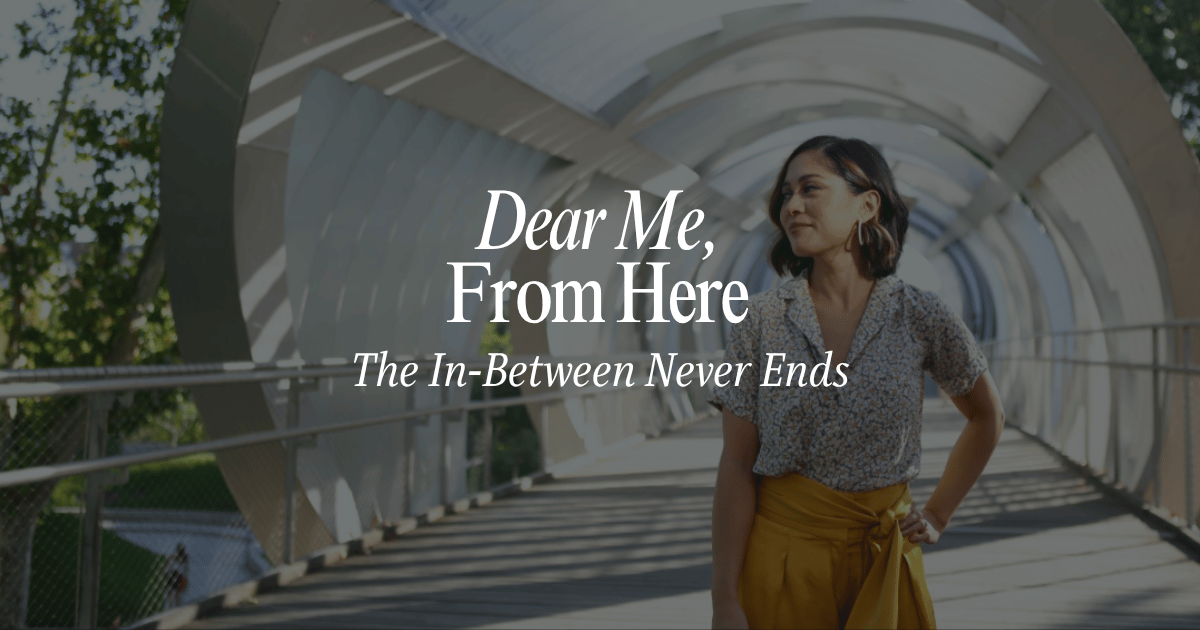
Madrid, May 2026
Dear Younger Me,
You think you’re moving to Madrid for a year… two years, tops.
In June 2010, you will pack two suitcases, a carry‑on, and a set of plug adapters for Madrid. You’ll have a plan and a one‑way ticket.
Sixteen years later, you’ll still be here.
The adapters will be long gone. The adapting won’t stop.
You actually came to Madrid first in 2007 to study abroad. You fell in love with the city before you knew what to do with that feeling — the light, the pace, the way people made time for each other, the tapas and the tardeos. You went back to the US to finish your degree and graduate. But you couldn’t stop thinking about Madrid.
In the summer of 2010, you came back. The city was aglow with the shared euphoria of the World Cup win in South Africa, Shakira’s “Waka Waka” song playing on loop. And in the midst of it all, you fell in love with a Spaniard.
(The official language in your house will one day be Spanglish. Your adopted cat will be forever confused.)
You grew up code‑switching. American at school, something else at home. Reading rooms before you understood not everyone did that automatically.
You learned that the famous second question (1. “Where are you from?”; 2. “No, where are you really from?”) will follow you wherever you go. You learned that you can either clench your fists or open your hands and share your story. You chose the latter.
You won’t find the term Third Culture Kid until your twenties — well into your time in Spain. When you do, something in your chest will loosen.
The in‑between won’t be new. You just won’t know yet that Spain won’t end it.
What you’ll learn slowly is this: the switching never becomes automatic. Every room is still a small decision. You’ll decide which register. You’ll ask yourself how much directness to bring to each conversation. You’ll ask how much cushion to add before each ask.
You’ll ask your husband for help re-writing your Spanish work emails for years — not for grammar, for tone. He’ll remove the American politeness. The Filipino indirectness. Hand you back something efficient and correct that doesn’t quite sound like you, but works for the person you’re addressing. You’ll get faster at catching it yourself.
You won’t always know whether you’re adapting or erasing. That question won’t ever fully resolve… it’ll just become part of how you navigate life here.
Here’s something it will take a long time to understand: no matter how fluent your Spanish gets, you’ll always carry the cultures that shaped you.
For a while that will feel like a qualifier. She speaks well, but.
Eventually, you’ll understand it differently. The American directness, the Filipino restraint, the Spanish warmth you slowly absorb — all of it is yours. All of it travels with you.
Finding your people will take time.
Your parents will find community through shared language — literally. For you, it won’t work that way. You’ll translate yourself in every room, regardless of what language you’re speaking.
Community, it turns out, isn’t always about shared origin. It’s about being chosen, and choosing back.
The people who will be in your life sixteen years from now? They found you sideways, slowly, across languages and years. They know which version of you is which. They know you better than many people back home ever will.
The firsts will come slowly, then faster.
The first time you make a joke (and get the timing right!) in Spanish. The first time you have therapy in Spanish. The first argument you win with your husband — in Spanish, which will feel like a line crossed. The first paid talk you delivered entirely in a second language. The first lunch and sobremesa with your Spanish in‑laws, all talking and laughing at once. The first time you see your name in a Spanish newspaper. The first consulting deal you close without anyone pausing at your accent.
Each time, you’ll think: this is it. Now I belong here.
It won’t be.
The second question — “Where are you really from?” — will follow you no matter how fluent you get. It will still be waiting at year five, year ten, year sixteen.
You’ll learn to use it as an opening instead of a verdict. That will take longer than it should.
Resist the trap of the “That’s so Spanish” refrain. You’ll hear it from expats who’ve been here five years, ten years — a kind of weary superiority that passes for insight. You’ll be tempted by it yourself.
Spain will be navigating its own in‑between too. Your mother‑in‑law will go from washing clothes in a river to WhatsApp in her lifetime. You of all people will understand that in‑between eventually, and you’ll learn to bring that grace to your interactions.
The pause before you react — it’s not wrong, it’s just different — that’s where your values live.
It’s also what you’ll eventually train professionally… first in communications, then as an inclusion strategist, then as a counsellor-in-training.
The in‑between will teach you that first.
And then 2020… your tenth year here.
The city will shut down. Then reopen. But something in you won’t reopen with it.
While everyone is afraid of a virus, you’ll be afraid of the place you call home turning against you. People will step away to avoid you on buses. Move to the other side of supermarket aisles. Look past you — or through you — in places you used to move through with ease.
You’ll have residency. You’ll have friends. You’ll have a decade under your belt.
And still, your world will narrow. Routes will shorten. Social contact will thin. The door of your own building will become a negotiation with your nervous system. Your shoulders will learn the calculation before you do. Which streets are safe for you? What times can you leave? Will the shop be crowded when you go?
You’ll tell yourself this is temporary. That ten years in, you should have been more embedded, more resilient, more immune.
Instead, you’ll realize that the work you’re doing around inclusion for companies is a feeling you aren’t guaranteed yourself.
And it will make you question whether or not Spain is still the right place for you.
What brings you back won’t be willpower. It will be running. One block. Then a street. Then a trail. Then a city, reclaimed at the pace of your own breath.
The pandemic won’t change the terms of your belonging to the place you’ve called home. It will make them visible.
During this time, you’ll re-examine your relationship with the words “expat” and “immigrant”. You realize that despite actively choosing the first one — a choice your parents never got to make — you’ve been assigned the second by your adopted country. That assignment means your belonging here is, in fact, conditional. The heartbreak of that realization will take you years to claw your way out of.
You’ll keep building anyway.
You’ll become and un‑become yourself here, faster than you expect. Things you once absorbed without question will start to land differently — sharper, louder, harder to ignore.
It’s not because Madrid makes you harder, but because it keeps handing you back to yourself. Eventually, you’ll stop arguing with what you find, and start surrendering to it.
On the way, you’ll outgrow people. Some who have known older versions of you. Some you have tolerated too long.
The ones who stay become the village you’ve always sought.
Your heart will always be split — between the people here and the people there, between the place you came from, and the place you built. Most days that’s something you’d describe as a blessing. Some days it’s a silent grief with no clear ritual to mark the transition.
The grief and the gratitude won’t sit on opposite ends of a scale. They’ll just both be there, at the same time, some days heavier on one side and some days even. You won’t always be able to tell which is which. That won’t be confusion. That will just be what it feels like.
Give yourself grace when the grief comes. You’re allowed.
Your American family and friends today will still reach for the version of you who left. Sometimes they’ll find someone else standing there. You will, too. The longer you’re here, the harder it will get to plug back in when you go back. You’ll be the forever foreigner in both directions eventually. That won’t be a failure. It will just be the shape of the life you chose.
You’ll go quiet sometimes when you’re processing. From the outside, it will look like you’re disappearing. But it’s not. It will just be you finding your way back to what aligns with your values before you speak.
Some people won’t understand that. The right ones will wait.
Last June, for the first time, you won’t mark your Spanniversary. You’ll just live the day you arrived with a silent acknowledgment of the time passing.
And when you travel outside Spain with your partner, you’ll tell someone you’re both from Madrid. The words will come out easily. No pause. No correction.
That will matter. Even if it doesn’t feel like it does.
Integration won’t be a finish line.
The in‑between won’t resolve. It will deepen. Shift. Become something you can live inside. Some days it will be quiet enough to forget. Some days you’ll feel it in your shoulders before you can name it.
The adapters were never going to be enough. Not because you failed to adapt. Because this was never a problem with a step-by-step program or tick-box solution.
The grief and the joy of building a life here won’t cancel each other out.
You will understand your parents differently now. The way they navigated their own in‑between. The calculations they made that you couldn’t see. That lesson will be unexpected.
You will be more yourself here than you’ve been anywhere else.
Some days that will feel like freedom. Some days it won’t.
Both will still be true.
Love,
Kay
Kay Fabella is a Filipina-American Third Culture Kid, former inclusion strategist, and counselor‑in‑training who has called Madrid home since 2010.
She writes Edgewalkers Collective on Substack for long‑term expats and global citizens navigating the “no longer new, still not home” phase of life abroad — giving language, story, and emerging research to what many experience as migratory grief.
If you want to connect with Kay:
You can:
Read Edgewalkers Collective: kayfabella.substack.com
Book an Expat Orientation Conversation: cal.com/kay-fabella
Connect on LinkedIn: linkedin.com/in/kayfabella
PS. Hey, it’s Viv here. If you’re thinking about moving abroad and occasionally find yourself standing in the middle of your house wondering, “But what would I do with all of this stuff?” I made something for you.
We Are Not Taking The Whole House With Us is a short, practical email series that will help you figure out where to start and how to move forward without getting stuck or spiraling out.
PPS. The May Book Club LIVE discussion of The Year of Living Danishly by Helen Russell is happening on Sunday! Here are the details.
 | A guest post by
|